Chaos · reservoir computing
Minimal Reservoir Computing
The notebook · live in your browser, code and all
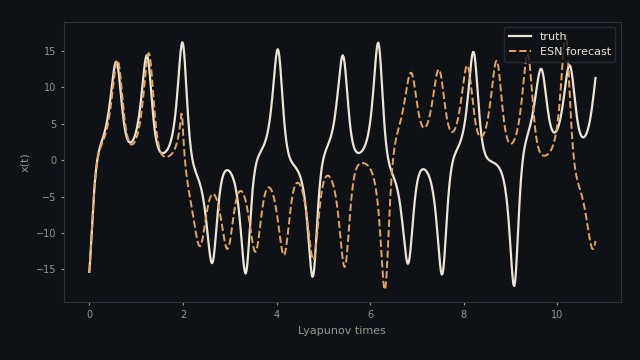
open full screen ↗A reservoir computer forecasts chaos by pushing a signal through a big fixed random network and training only a linear readout. The question I cared about: how small can the reservoir get before it stops working? I map prediction quality across the sparsity and spectral-radius plane, scoring each setup by how many Lyapunov times its forecast stays valid, with the Lyapunov exponent computed straight from the dynamics rather than looked up. I run it on the Lorenz and Rossler flows and the Henon map to find the smallest network that still tracks each attractor.